
Prioritizing Safety in Chlorine Transfer: Materials, Testing, and Design Considerations
Written by Nathan Thomas
Chlorine is used far and wide, across many industries for various applications. Although chlorine is very common, many people are unaware of how reactive it is with certain materials. Thorough design considerations are required for process equipment to resist the highly reactive chemical properties of chlorine. To ensure safety and minimize the chance of equipment failure, choosing the correct transfer components is key. Below, we will go through the key considerations for safe industrial chlorine transfer.
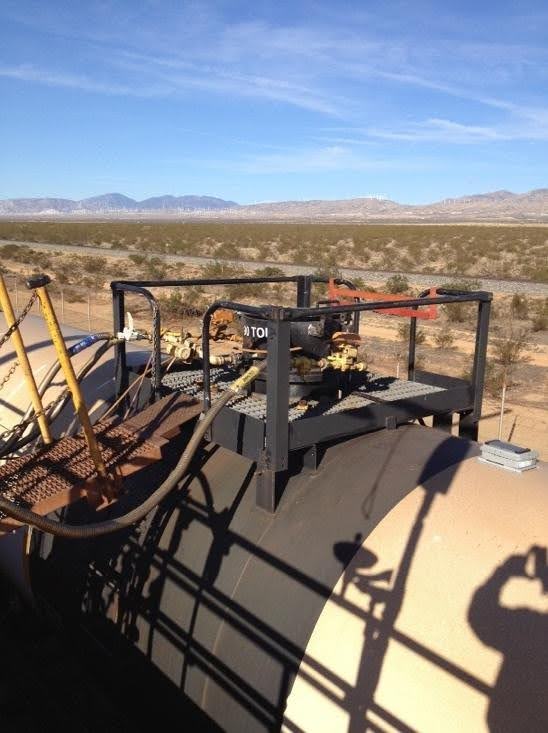
Chlorine Applications
From the treatment of drinking water to crop protection for the agriculture industry, we are highly dependent on chlorine. Even the average consumer encounters it regularly in the form of bleach. There are a wide variety of industries and applications for chlorine such as:
-
PVC/plastics manufacturing
-
Crop protection for agriculture
The Chlorine Institute Pamphlet 6, Appendix A
Chlorine is highly reactive and can be very demanding on transfer components. If these components are improperly chosen, it can result in equipment failures. Luckily, The Chlorine Institute, the technical trade association for chlorine-related matters, lays out a set of guidelines for chlorine transfer hoses in The Chlorine Institute Pamphlet 6, Appendix A.
When hoses are specified for chlorine service, metal corrugated hoses are generally preferred over non-metallic options, which are more vulnerable to media permeation, temperature constraints, fitting ejection, and fire-safety issues. There are many design considerations for chlorine transfer hoses. When metal hose is specified, The Chlorine Institute advises the following:
-
Core, braid, and fittings should be either Monel 400 or Hastelloy C276
-
Chafe guard/outer covering should be Series 300 stainless steel
-
-
Types of fittings:
-
Male NPT, (Schedule 80)
-
Type A lap joint, 300 Class ASME flange (Schedule 80)
-
CGA 820 connection (for chlorine cylinders and ton containers)
-
Material selection is one of the most crucial factors in designing a safe chlorine transfer hose assembly. A standard stainless steel alloy like 316 is not to be used in chlorine applications because the reactivity of the chlorine with steel can cause corrosion, leading to potential leaks/premature hose failure. Monel 400 and Hastelloy C276 are both nickel-based alloys, which are far more electrochemically stable than stainless steel, which is iron-based. Hence, these are the recommended alloys for chlorine service.
From a performance and testing standpoint, there are a series of criteria that the hoses should adhere to, including:
-
375 PSIG maximum allowable working pressure (MAWP) at room temperature for hoses larger than ½” nominal diameter and 500 PSIG MAWP at room temperature for hoses smaller than ½” nominal diameter
-
5:1 safety factor for burst pressure (MAWP is 1/5 burst pressure)
-
-
Vacuum capable – will not deform/collapse under full vacuum at room temperature
-
Pneumatic testing with air, nitrogen, or helium gas at 2 times the MAWP for at least 10 minutes submerged in water
-
Sample hoses shall not burst at less than 5 times the MAWP
-
Helium mass spectrometer testing to a maximum leak rate of 5 x 10⁻⁶ std cc/sec
-
100% radiograph weld inspection and/or dye penetrant testing
-
Deformation Pressure: The pressure at which there is a marked permanent increase in internal volume without a corresponding increase in length. The deformation pressure must be greater than one and a half [1.5] times the MAWP.
-
Capable of operating from -40°F to 122°F
Note that there are many more important considerations and responsibilities for the manufacturer, distributor, and owner of chlorine transfer hoses outlined in the pamphlet.
.jpg)
Hose Master’s C276 Hoses
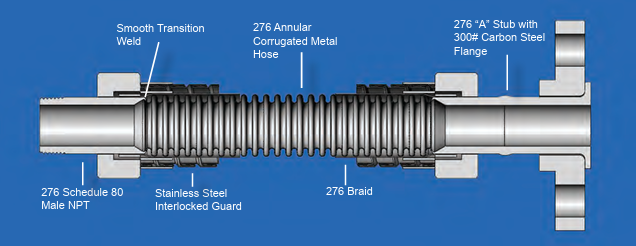
ChlorSafe™ is Hose Master’s C276 chlorine transfer assembly designed with the highly reactive properties of chlorine in mind and is manufactured in compliance with The Chlorine Institute’s guidelines in Pamphlet 6, Appendix A.
The advanced fabrication method that Hose Master uses to create these hose assemblies is a vital feature to ensure hose longevity. All ChlorSafe™ assemblies have smooth transition welds, which minimize crevices and fissures which can be potential sites for corrosion, especially in chlorine applications. Another important part of ChlorSafe™ assemblies is the interlocked hose, which is an external guard to protect the inner transfer hose and maximize its service life.
Hose Master takes careful measures throughout the manufacturing process to ensure high-quality hose assemblies that perform reliably. With chlorine as widespread and integral to industrial manufacturing as it is today, quality is not something to compromise on. To request a C276 hose, contact Hose Master today.
-
When to Use Flexible Metal Products
-
Select the Right Hose for Your Application
-
Select the Right Corrugated Metal Hose
-
Select the Right Stripwound Metal Hose